
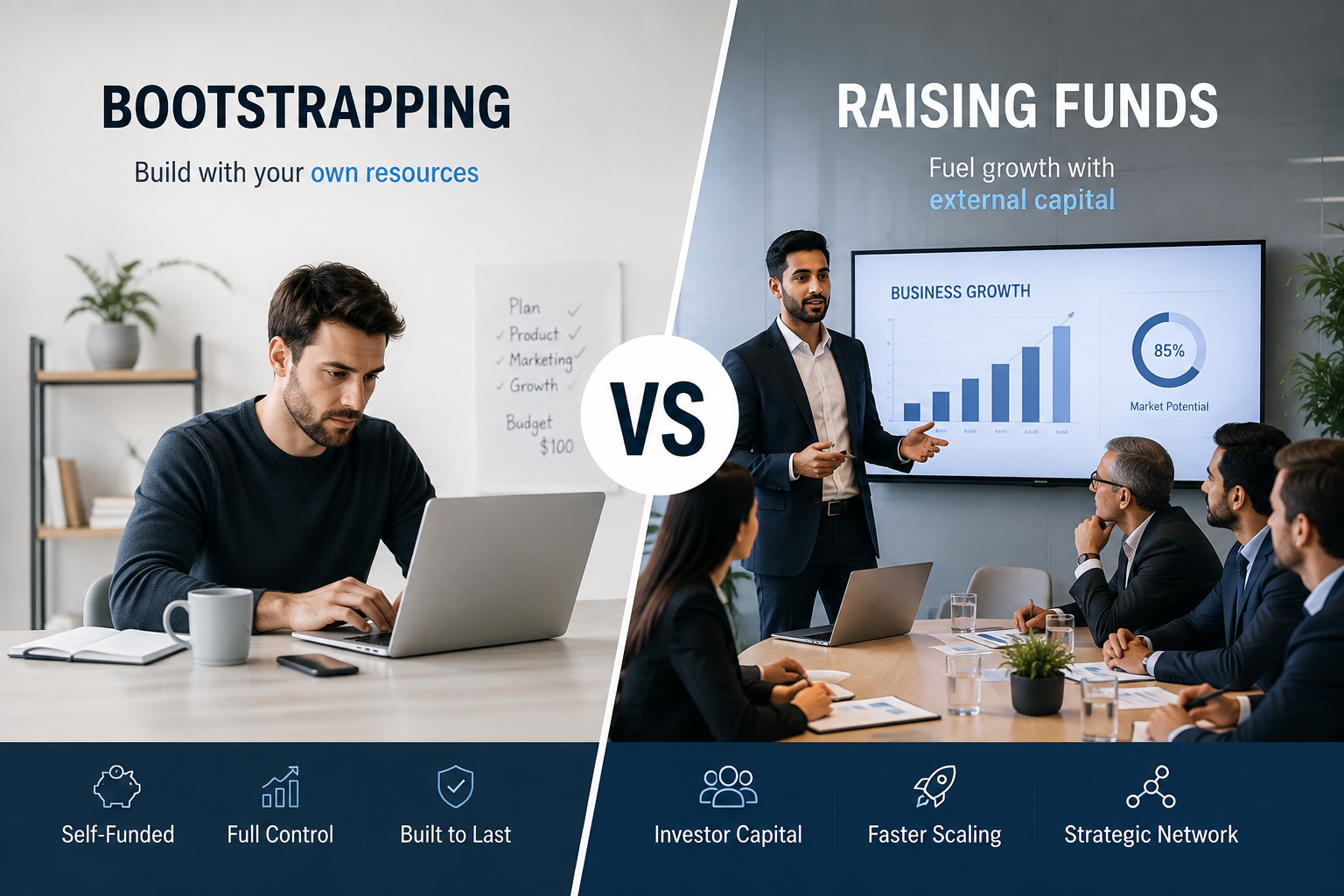
Bootstrapping vs Raising Investment: Which Is Better for UAE Startups?
Introduction
Every successful startup begins with an idea, but turning that idea into a thriving business requires one essential ingredient—capital. One of the first decisions entrepreneurs face is whether to fund the business themselves or seek investment from external investors.Some founders choose to bootstrap, using personal savings and business revenue to grow steadily while maintaining full ownership. Others raise capital from angel investors or venture capital firms to accelerate growth, hire talent, and expand more quickly.Neither approach is right or wrong. The best choice depends on your business model, growth ambitions, financial resources, and long-term vision.
In this guide, we’ll compare bootstrapping and raising investment, explore the advantages and challenges of each approach, and help you decide which funding strategy is best for your startup in the UAE.
At a Glance
| Bootstrapping | Raising Investment |
|---|---|
| Self-funded | Investor-funded |
| Full ownership | Shared ownership |
| Steady growth | Faster growth potential |
| Lower financial pressure | Greater access to capital |
| Full decision-making control | Investor involvement |
Quick Take: If your business can grow through customer revenue, bootstrapping may be the ideal path. If your startup requires significant capital to develop, scale, or enter the market quickly, raising investment may be a better option.
Why Choosing the Right Funding Strategy Matters
The way you fund your startup influences far more than your bank balance. It affects how quickly you can grow, the level of control you retain, the risks you take, and the decisions you make as your business evolves.A funding strategy that works well for a software startup may not be suitable for a consulting firm or e-commerce business. Understanding your business needs before choosing a funding path can help you build a stronger and more sustainable company.
FounderX Insight: Don’t ask, “How can I raise money?” Start by asking, “What does my business actually need to grow?” The answer often points you toward the right funding strategy.
Understanding Bootstrapping
Bootstrapping means building and growing your business using your own financial resources rather than relying on external investors. This could include personal savings, revenue generated by the business, or reinvesting profits back into the company.Many successful businesses begin this way because it allows founders to maintain complete ownership while growing at a pace they can comfortably manage.
Why Entrepreneurs Choose to Bootstrap
> Complete ownership of the business
> Full control over decision-making
> No investor pressure
> Greater financial independence
> Ability to grow at your own pace
> Focus on profitability from the beginning
Challenges of Bootstrapping
> While bootstrapping offers independence, it also comes with limitations.
> Limited access to capital
> Slower business growth
> Personal financial risk
> Smaller marketing and hiring budgets
> Growth depends largely on business revenue
FounderX Recommendation: If your business can generate revenue early and doesn’t require heavy upfront investment, bootstrapping allows you to grow while maintaining complete control over your vision.
Understanding Raising Investment
Raising investment means securing capital from external sources such as angel investors, venture capital firms, or strategic investors in exchange for equity or ownership in your business.Instead of relying solely on personal savings or business revenue, startups receive funding to accelerate growth, develop products, expand operations, or enter new markets.For many startups, especially those in technology or innovation-driven industries, external investment can provide the financial resources needed to scale much faster than organic growth alone.
Why Startups Raise Investment
Many founders seek investment to:
> Launch products faster
> Hire experienced talent
> Expand into new markets
> Increase marketing and customer acquisition
> Develop new technologies
> Scale operations without relying solely on revenue
Access to additional capital allows startups to focus on growth opportunities that may otherwise take years to achieve.
Challenges of Raising Investment
Investment brings opportunities—but it also comes with responsibilities.
Founders should be prepared for:
> Sharing ownership of the business
> Investor involvement in key decisions
> Pressure to achieve growth targets
> Regular performance reporting
> Longer fundraising and due diligence processes
Raising investment isn’t just about securing funds—it’s about building a long-term relationship with people who now have a stake in your company’s success.
FounderX Recommendation: If your business requires significant upfront investment to build technology, expand rapidly, or capture market share, raising capital may provide the momentum needed to achieve your growth objectives.
Bootstrapping vs Raising Investment: Side-by-Side Comparison
| Factor | Bootstrapping | Raising Investment |
|---|---|---|
| Ownership | Full ownership | Shared ownership |
| Decision Making | Founder has complete control | Investors may influence major decisions |
| Business Growth | Gradual and revenue-driven | Faster expansion potential |
| Financial Risk | Personal financial commitment | Shared financial responsibility |
| Access to Capital | Limited to available funds | Higher funding potential |
| Business Focus | Profitability and sustainability | Growth and scalability |
| Best For | Service businesses & SMEs | High-growth startups |
Founder’s Perspective
Neither funding strategy is automatically better.If your startup can grow through customer revenue and doesn’t require heavy upfront investment, bootstrapping allows you to build the business on your own terms.If your business depends on rapid expansion, product development, or entering a competitive market, raising investment may help you scale more efficiently.The best choice isn’t determined by trends—it’s determined by what your business actually needs.
Which Funding Strategy Is Right for Your Startup?
Choosing between bootstrapping and raising investment isn’t about following trends—it’s about understanding what your business needs at its current stage. Every startup is different, and the right funding strategy should support your goals, growth plans, and financial reality.
Here’s a simple way to evaluate which approach may be the better fit.
Choose Bootstrapping If…
> Want to maintain full ownership of your business
> Can start generating revenue early
> Prefer steady and sustainable growth
> Operate a service-based or low-cost business
> Want complete control over business decisions
> Are comfortable growing at your own pace
This approach works well for entrepreneurs who value independence and want to build a business through profitability rather than external funding.
Consider Raising Investment If…
Raising investment may be the better option if you:
> Need significant capital before generating revenue
> Are building a technology or product-based startup
> Plan to scale rapidly
> Want to expand into multiple markets
> Need to hire a larger team early
> Are comfortable sharing ownership with investors
For startups with ambitious growth plans, external investment can provide the resources needed to accelerate expansion and compete in fast-moving industries.
Decision Framework
Still unsure? Use this simple guide.
| Question | If Your Answer Is Yes | Recommended Approach |
|---|---|---|
| Can your business generate revenue quickly? | Yes | Bootstrapping |
| Do you need large upfront investment? | Yes | Raising Investment |
| Is maintaining full ownership important? | Yes | Bootstrapping |
| Is rapid growth your top priority? | Yes | Raising Investment |
| Can you comfortably self-fund the business? | Yes | Bootstrapping |
| Are you willing to share equity for faster expansion? | Yes | Raising Investment |
Real-World Examples
Example 1 – Digital Marketing Agency
A founder launching a digital marketing agency needs a laptop, software subscriptions, and industry expertise. Since the business can begin generating revenue quickly with relatively low startup costs, bootstrapping is often a practical and sustainable choice.
Example 2 – AI SaaS Startup
An entrepreneur developing an AI-powered software platform needs funding for product development, cloud infrastructure, hiring engineers, and customer acquisition before significant revenue is generated. In this case, raising investment may provide the capital required to scale effectively.
FounderX Insight: The best founders don’t raise investment because everyone else is doing it. They raise it when it helps achieve a clear business objective. Likewise, they don’t bootstrap simply to keep 100% ownership—they choose it because it aligns with their business model.
Common Mistakes Founders Make
Before deciding on a funding strategy, avoid these common pitfalls:
> Raising investment before validating your business idea
> Bootstrapping without a realistic financial plan
> Focusing on funding instead of building a product customers want
> Giving away too much equity too early
> Underestimating the cash flow needed to sustain operations
Many successful startups don’t fail because they lacked funding—they fail because they chose a funding strategy that didn’t match their business model.
Why Choose FounderX?
Every startup journey is different, and there’s no universal funding strategy that works for every business. At FounderX, we help entrepreneurs evaluate their business model, growth objectives, and financial requirements to make informed decisions from the very beginning.
Whether you’re planning to bootstrap your startup or prepare for investor funding, our team provides practical guidance to help you build a strong business foundation and navigate the UAE business landscape with confidence.
Our Startup Support Services
> Business Licensing & Registration
> Corporate Bank Account Assistance
> Corporate Tax & VAT Registration
> Business Advisory
> Ongoing Business Support
Frequently Asked Questions
Is bootstrapping better than raising investment?
> Neither option is universally better. Bootstrapping offers greater control and ownership, while raising investment provides access to capital that can accelerate growth. The right choice depends on your business model and long-term goals.
Can I bootstrap first and raise investment later?
> Yes. Many successful startups begin by bootstrapping to validate their business idea and generate initial traction before approaching investors for funding.
What type of businesses usually require investment?
> Technology startups, SaaS companies, AI businesses, HealthTech platforms, FinTech startups, and marketplace businesses often seek external investment because they require significant upfront capital to develop products and scale operations.
Will investors own my company?
> No. Investors typically receive an agreed percentage of equity in exchange for their investment. The amount depends on the valuation of your business and the terms of the investment agreement.
Do all startups need investors?
> No. Many successful businesses are built without external funding. Service-based businesses, consultancies, agencies, and freelancers often grow sustainably through customer revenue and reinvested profits.
When should I consider raising investment?
> Consider raising investment when your business has a validated idea, a scalable business model, clear growth opportunities, and a genuine need for additional capital to accelerate expansion.
Conclusion
Choosing between bootstrapping and raising investment is one of the most important financial decisions a founder will make. While bootstrapping offers independence and complete ownership, raising investment can provide the capital needed to grow faster and compete in larger markets.The right approach depends on your business model, industry, financial resources, and long-term vision. Rather than following what other startups are doing, focus on choosing the funding strategy that best supports your goals and positions your business for sustainable growth.With careful planning and the right guidance, you can build a startup that is not only well-funded but also well-prepared for long-term success.